Tandem Mass Spectrometry (MS/MS) in GC‑MS Analysis: Technology, Applications & Insights 🔬
Table of Contents
- 1. Introduction: What is GC‑MS and GC‑MS/MS?
- 2. Fundamental Principles & Workflow
- 3. Technical Components & Instrument Diagram
- 4. What is Tandem Mass Spectrometry (MS/MS)?
- 5. Key Terminology: Analyte, Matrix, Eluent Fractions
- 6. Why Inject into Vacuum? Supersonic Molecular Beam Explained
- 7. Applications in Clinical, Pharmaceutical, and Environmental Analysis
- 8. Advantages of GC‑MS/MS over GC‑MS
- 9. Summary & Outlook
- 10. References & Further Reading
1. Introduction: What is GC‑MS and GC‑MS/MS?
GC‑MS, short for gas chromatography–mass spectrometry, is an analytical technique that combines gas chromatography’s separation capability with mass spectrometry’s ability to identify and quantify compounds. GC‑MS/MS (also called tandem mass spectrometry) builds on this by performing multiple rounds of mass spectrometry, allowing for enhanced sensitivity and specificity.
2. Fundamental Principles & Workflow
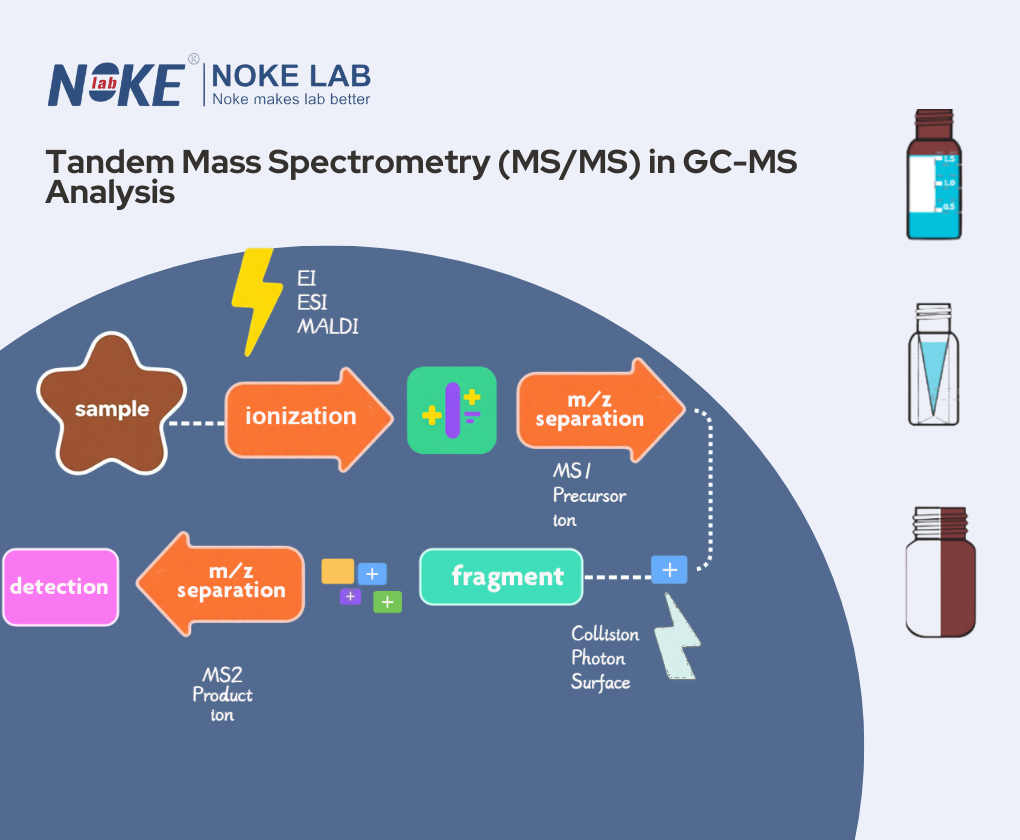
In GC, volatile compounds are separated based on their boiling points and polarity. The separated compounds enter the MS, where they are ionized and analyzed based on mass-to-charge ratio (m/z). Tandem MS involves multiple stages: ions from the first MS (MS1) are fragmented and reanalyzed in a second MS (MS2), improving analytical depth.
3. Technical Components & Instrument Diagram
A GC‑MS/MS system typically consists of an autosampler, GC column, interface, ion source, quadrupoles or ion traps, detectors, and vacuum system. Injection into a vacuum enables the formation of a supersonic molecular beam, which improves resolution and reduces ion scattering.
4. What is Tandem Mass Spectrometry (MS/MS)?
MS/MS refers to a method where selected ions are fragmented into product ions for detailed structural analysis. This sequential process provides richer molecular information and is widely used in proteomics, drug testing, and metabolomics.
5. Key Terminology: Analyte, Matrix, Eluent Fractions
- Analyte: The substance of interest being measured in the sample.
- Matrix: All other components in the sample apart from the analyte.
- Eluent fractions: Portions of liquid leaving the chromatographic column. Direct transfer of eluent fractions into the MS improves sensitivity and repeatability by reducing contamination risks.
6. Why Inject into Vacuum? Supersonic Molecular Beam Explained
Injecting samples into a vacuum allows for the generation of a supersonic molecular beam—molecules cooled and focused by rapid expansion. This enhances ion stability and minimizes unwanted collisions, crucial for accurate mass analysis.
7. Applications in Clinical, Pharmaceutical, and Environmental Analysis
GC‑MS/MS is used for detecting drugs, hormones, pollutants, and toxic substances in blood, urine, and environmental samples. Its ability to detect trace levels makes it invaluable in clinical toxicology and forensic science.
8. Advantages of GC‑MS/MS over GC‑MS
- Greater sensitivity and lower detection limits
- Enhanced selectivity and signal-to-noise ratio
- Better quantitation of complex mixtures
- Reduced background interference
9. Summary & Outlook
GC‑MS/MS is a powerful tool in modern analytical chemistry, offering superior accuracy, specificity, and trace-level quantification. As technology advances, it will continue to play a central role in clinical diagnostics, research, and regulatory testing.
References and Further Reading
- Wikipedia, “Tandem mass spectrometry”
- ScienceDirect Topics, “Tandem mass spectrometry”
- Diverse Daily, “Principles and Applications of Gas Chromatography-Tandem Mass Spectrometry”
- Agilent Technologies, “What is GC-MS/MS?”
- Shimadzu, “Understanding GCMS-TQ”
📚Related Articles
Micro Size, Pure Keeps!
Tiny Parts. Mighty Manufacturing. PureChromatography Beyond.
ノーク・ラボ