Mass Spectrometry Fundamentals: In-Depth Guide to GC-MS, GC-MS/MS, and Related Techniques
Table of Contents
- 1. Introduction to GC-MS and GC-MS/MS
- 2. Fundamental Principles and Workflow
- 3. Technical Components of a GC-MS Instrument
- 4. Applications
- 5. Data Analysis and Interferences
- FAQ
- References
1. Introduction to GC-MS and GC-MS/MS
Gas chromatography mass spectrometry (GC-MS) is an analytical technique that combines the separation power of gas chromatography (GC) with the molecular identification capabilities of mass spectrometry (MS). It is widely used in fields such as environmental monitoring, forensic toxicology, and pharmaceutical analysis[1][2].
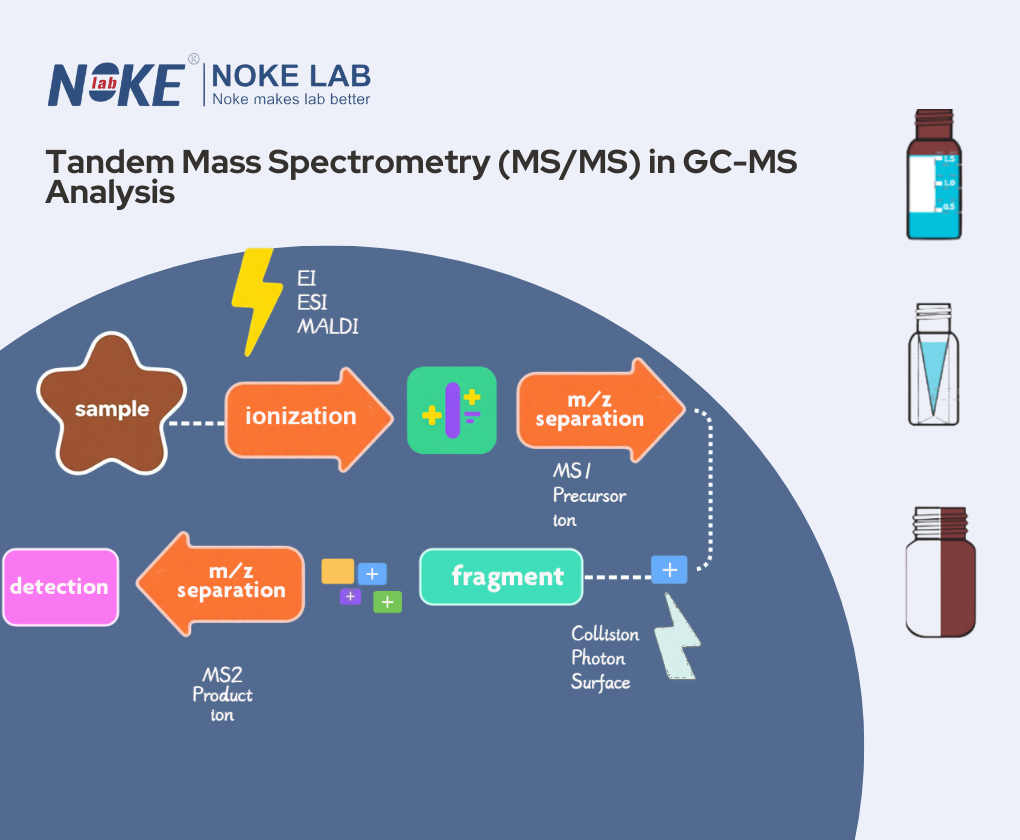
The tandem variant, GC-MS/MS (or gc ms ms ms), introduces a second mass analyzer stage, improving selectivity by fragmenting selected ions and analyzing their product ions, allowing for enhanced detection of complex matrices[3].
2. Fundamental Principles and Workflow
- Gas chromatography (GC) separates volatile and semi-volatile compounds based on their partition between a stationary phase and a mobile gas phase[4].
- After separation, analytes enter the mass spectrometer (MS), where molecules are ionized (commonly via electron ionization, EI), producing ions sorted by their mass-to-charge ratio (m/z)[5].
- The tandem system (gc ms ms analysis) uses collision-induced dissociation (CID) to fragment precursor ions, improving specificity[3].
This workflow is standard in gc-ms analysis, gc ms drug test, and gc ms spectroscopy organometallics applications.
3. Technical Components of a GC-MS Instrument
A typical gc ms instrument consists of:
- Injector port and capillary column housed in a temperature-controlled oven[4]
- Transfer line to the ion source (usually EI or CI source)[5]
- Mass analyzer(s): Quadrupole, Time-of-Flight (TOF), or Ion Trap for gc ms ms[6]
- Detector: Electron multiplier or Faraday cup[5]
- Data acquisition system linked to c ms database for spectral matching[7]
Leading providers of gc ms machine and gc-ms components & accessories include Agilent Technologies, Thermo Fisher Scientific, and Shimadzu[8].
4. Applications
- GC-MS drug test and gc/ms drug test are regulatory standards for drug screening, with detection times varying based on analytes and matrices[9].
- GC ms spectroscopy organometallics facilitates trace-level detection of metal complexes in environmental and biological samples[10].
- Advanced setups such as gc gc ms and gc lc ms ms allow separation of highly complex samples with enhanced resolution[11].
5. Data Analysis and Interferences
Proper interpretation of gc ms data relies on spectral libraries (e.g., NIST, Golm Metabolome Database)[7].
Common challenges include gc ms interference from coeluting compounds, which tandem MS workflows help mitigate[12].
References
- Agilent Technologies. Introduction to Gas Chromatography–Mass Spectrometry.
- Wikipedia. Gas Chromatography–Mass Spectrometry.
- EAG Laboratories. Tandem Mass Spectrometry (MS/MS) Overview.
- University College London. Gas Chromatography Principles.
- East Texas A&M University. Mass Spectrometry Fundamentals.
- Thermo Fisher Scientific. Mass Analyzer Types in GC-MS.
- NIST. Mass Spectral Library and Data Interpretation.
- Shimadzu. GC-MS Instrumentation and Accessories.
- Scientific Working Group for Forensic Toxicology (SWGTOX). Drug Testing by GC-MS.
- RSC Publishing. Organometallics Analysis by GC-MS.
- De Gruyter. Advanced GC×GC-MS Techniques.
- Separation Science. Managing Interferences in GC-MS Analysis.
- Analytical Chemistry. Retention Time Accuracy in Chromatography.
📚Related Articles
Micro Size, Pure Keeps!
Tiny Parts. Mighty Manufacturing. PureChromatography Beyond.
Laboratório Noke